Best Online Pokies Real Money Australia: A Buyer’s Guide
 Available in US
Every real-money online pokies site an Australian can reach is licensed somewhere else. There is no Australian licence for online pokies, none has ever existed, and the Interactive Gambling Act 2001 makes it an offence to offer one to anyone in Australia. The 10 sites reviewed on this page are the ones Australians actually use — Curacao, Anjouan and Kahnawake-licensed casinos that run past the block rather than inside the law. That is the starting line. Reading past it requires knowing what offshore costs the player the licence would have guaranteed.
Verified 3 September 2026 against the ACMA register of blocked sites and Casino.Guru public licence records.
Table of Contents
- Playing real-money pokies online in 2026: what you’re really walking into
- The top 10 real-money pokies sites Australian players actually use in 2026
- Why every online pokies site you see is offshore — and what that costs you
- PayID and beyond: how your money moves at Australian-facing pokies sites
- Why your 2026 pokies bonus is smaller than it looks
- Pokies in your pocket: the app reality for Australian players in 2026
- Free pokies, real lessons: what demo mode actually teaches you
- When the reels stop being fun: help that actually works
- How we evaluated every pokies site on this page
- Your money, your call: what to do with everything you’ve just read
- Frequently Asked Questions
Playing real-money pokies online in 2026: what you’re really walking into
The word “real money” is doing real work in this search. It tells the operators a player is past the demo, past the free-play, and ready to deposit. It also signals something the marketing does not spell out: there is no Australian counterpart to the sites that answer. Every search result a player in Sydney or Perth sees is offshore, every comparison table is an offshore comparison table, and every IGA disclaimer at the top of those pages is the same IGA disclaimer. The market is not competitive in the way a domestic comparison implies. It is a single market — overseas — and a single prohibition — domestic.
What is prohibited to offer to a person in Australia is the online casino product itself: online pokies, online casino table games, and in-play sports betting. Permitted and licensable products are pre-event wagering on sport and racing, lotteries, and keno. The federal enforcer is the Australian Communications and Media Authority (ACMA); the prohibition sits in the Interactive Gambling Act 2001, tightened by the Interactive Gambling Amendment Act 2017. The licensee for permitted online wagering is, in practice, the Northern Territory, but the product licensed is wagering, not pokies.
That asymmetry is the frame for everything that follows. The player is not prosecuted — the Act targets the provider — but the player gives up every Australian protection that comes with an Australian licence, and gives it up knowingly, because no Australian licence exists to take. Competitor pages lead with the same disclaimer for the same reason: any ranking that pretended otherwise would be lying about what it is ranking.
The offshore-only reality in 2026
“Offshore” in the Australian pokies market is not a metaphor. Every domain in this space is registered outside the country, every operator is incorporated outside the country, and every licence on the wall is issued by a regulator that does not recognise Australian consumer law. The three jurisdictions the Australian market actually meets are Curacao, Anjouan (Comoros) and Kahnawake — in roughly that order of prevalence. Curacao reformed its licensing regime in 2024 and now issues under a single authority; Anjouan has become a faster, cheaper alternative for newer operators; Kahnawake has a longer history in the Canadian-regulated space and a smaller footprint among Australian-facing brands.
The ACMA has, since November 2019, directed Australian ISPs to block 1,564 illegal gambling and affiliate websites as at March 2026, and more than 225 illegal services have withdrawn from the Australian market since the 2017 amendment tightened enforcement. Blocking is DNS-level, not unbeatable, and the operators that remain know how to present under slightly different domains. The number is best read as a count of attempts that did not survive scrutiny, not as a complete list of what Australians reach.
The practical shape of this for the player is simple. No .au domain runs real-money online pokies because no Australian licence can issue to one. The browser the player opens, the deposit method the cashier accepts, the licence number on the footer — every one of those belongs to a jurisdiction that does not know the player exists and has no obligation to. That is what offshore means.
What separates a pokies site worth your money from one that isn’t
Four things determine whether an offshore pokies site is a usable option or an expensive lesson. They are not all weighted equally, but they are all necessary.
The first is RTP, the percentage of wagered money a pokie returns over time. A 96% RTP is the conventional floor for a “good” pokie; 97% and above is high; the best titles an Australian can reach sit above 98%, with NetEnt’s Mega Joker at 99.00% in its full-RTP configuration. The second is the game providers behind those titles — Aristocrat, Pragmatic Play, Nolimit City and Relax Gaming lead Australian-facing markets by studio presence, and a casino without them is running a thinner catalogue than the figures on its homepage suggest.
The third is the speed at which a real withdrawal actually arrives. PayID deposits credit in under 60 seconds at every verified AU-facing offshore casino, but withdrawals are a different mechanism and a different timing — fastest verified PayID withdrawals measured at 25 minutes (Hell Spin) and 35 minutes (Lucky7), with stated benchmarks of roughly five hours at slower operators. The fourth is bonus terms, which is where the marketing figures are most inflated and where the audit work is heaviest. A wagering multiplier, a max-cashout cap, and a bonus validity window together determine whether the headline bonus is a real bonus or a marketing figure.
A fifth criterion sits beneath the other four and rarely makes it onto a comparison table: licence transparency. A site that names its licence number and the entity it is issued to is doing the minimum. A site that obscures both should be assumed to be obscuring something else.
The harder question is what to do about RTP variants. Some offshore operators run reduced-RTP versions of popular pokies — a 95% version of a game that exists elsewhere at 99% — without disclosing the change. The only place to check is in-game, in the paytable or information panel. A pokie that does not show its RTP clearly is one to walk away from.
New pokies and trends Australian players should know about in 2026
The mechanics shaping the Australian-facing pokie market this year are concentrated rather than scattered. Megaways, Hold and Win, high-volatility jackpots and cluster-pay titles dominate the catalogue of every major studio; Bonus Buy options let players skip the base game for a fixed cost and chase the feature round directly; max-win ceilings on high-volatility pokies now reach 100,000x the bet, with 5,000x as a more typical top end. The trade is mathematical: the bigger the ceiling, the lower the hit frequency, the longer the bankroll has to last between features.
Aristocrat, Pragmatic Play, Nolimit City and Relax Gaming lead the studios players actually see. Hacksaw Gaming has built a strong presence on the high-volatility end. The Stake Originals brand — in-house provably fair games — has become a category of its own at crypto-first casinos. What the catalogues share is less interesting than what they differ on: each studio has a house RTP, each operator can run a reduced variant, and the difference between a 95% and a 99% game over a session of thousands of spins is not small.
The “new” pokies search a player is doing is largely a search for these mechanics rather than for genuinely fresh studios. What changes year to year is which mechanic is in fashion — Hold and Win has been the dominant fixed-jackpot format since 2022, Megaways remains the licence-of-choice for cascading-reel games, and cluster-pay titles keep appearing in the “new” category even when the underlying engine is years old. Reading the catalogue critically is more useful than reading it chronologically.
The top 10 real-money pokies sites Australian players actually use in 2026
Every site in this ranking is offshore. That is not a feature of the methodology — it is the structure of the Australian market. The IGA makes offering online pokies to a person in Australia illegal; no Australian licence exists for the product; therefore every site that offers it is operating from outside Australia. The ranking reflects accessibility and term transparency, not safety under Australian law, because no such safety exists.
| Operator | Licence jurisdiction | Welcome offer | Wagering multiplier | Game providers |
|---|---|---|---|---|
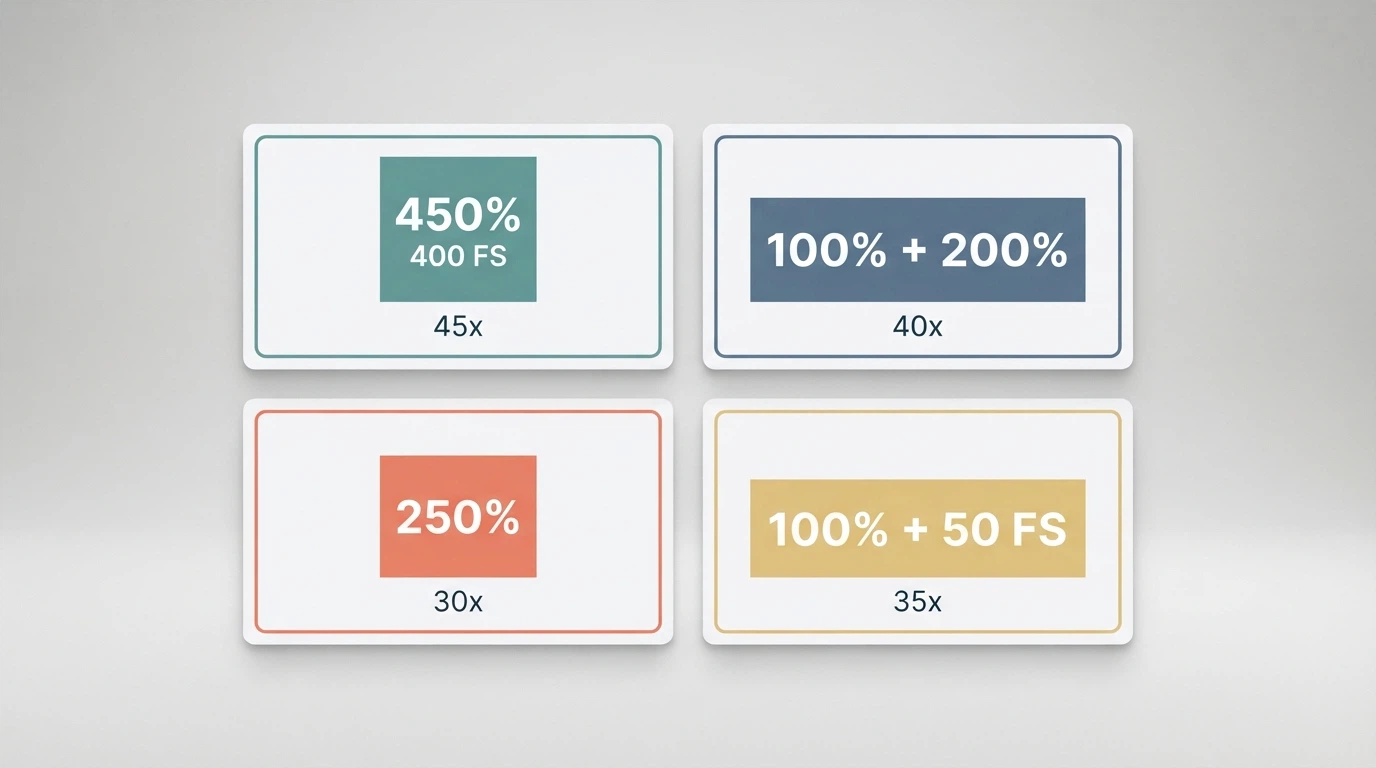
| Skycrown Casino | Curacao (OGL/2023/176/0095, Hollycorn N.V.) | 450% up to A$8,000 + 400 free spins across four deposits | 40x on bonus and free-spin winnings | IGTech, Booongo, Voltent, Pragmatic Play, 70+ studios |
| Rocket Play | Curacao Gaming Authority | 100% up to A$1,000 + 100 FS (1st deposit); 200% up to A$1,000 (2nd deposit) | 40x on bonus amount | Pragmatic Play, BGaming, Betsoft, Yggdrasil, 100+ studios |
| Royal Reels | — | — | — | — |
| WinSpirit | — | 100% match up to A$500 + 50 free spins | 30x bonus / 20x free-spin winnings | — |
| Stake | Curacao (Medium Rare N.V.) | No traditional welcome match; A$100,000 daily race and A$75,000 weekly raffle | Wager-free on promotional wins | Pragmatic Play, Evolution, Hacksaw Gaming, 40+ studios, Stake Originals |
| FairGO | — | — | — | RealTime Gaming |
| Bizzo Casino | Curacao (8048/JAZ2017-067, Antillephone N.V., via TechSolutions Group N.V.) | Welcome package including matched deposits and free spins | 35x | SoftSwiss platform, broad library |
| Rainbet | Anjouan (ALSI-152406029-FI2, RBGAMING N.V.) | 250% welcome bonus + free spins on Sweet Bonanza | 40x on first-deposit bonus and free-spin funds | 6,500+ games incl. Rainbet Originals |
| Scream Casino | — | — | — | — |
| Rocket Casino | — | — | — | — |
A dash in the table marks data this round of research did not confirm — not an absence of an offer, just an absence of verified figures. The methodology section at the foot of the page sets out what was checked and what was not.
Skycrown Casino: 450% match and 400 free spins — the biggest welcome package of the featured set
Skycrown sits at the top of the bonus-size table and the top of the bonus-maths table — both for the same reason. The package is 450% deposit match up to A$8,000 plus 400 free spins, split across the first four deposits: 125 free spins on Wolf Treasure with the first, 75 on Coin Volcano with the second, 50 on 15 Dragon Pearls with the third, and 150 on Mighty Wild: Panther Grand Diamond Edition with the fourth. The licence is Curacao, certificate OGL/2023/176/0095, held by Hollycorn N.V. The catalogue runs through IGTech, Booongo, Voltent, Pragmatic Play and 70+ other studios.
The terms behind the headline are where the value shrinks. Wagering is 40x on the bonus amount and 40x on free-spin winnings; the maximum bet during bonus play is A$7.50 per spin; the validity window is 14 days for standard bonuses and 5 days for high-roller tiers; the maximum cashout from any welcome bonus is capped at A$5,000, with regular bonuses capped at A$750. The minimum first deposit is A$30.
The verdict on Skycrown depends entirely on whether the player is reading the A$8,000 figure or the A$5,000 figure. The headline is a marketing figure. The cashout cap is the real one. A player who treats the package as a way to bankroll A$5,000 of conversion value at 40x is reading it correctly; a player chasing the A$8,000 number is reading the wrong line.
Rocket Play: 100% + 200% match with a 9.8 Casino.Guru safety rating
Rocket Play’s welcome package is a two-deposit structure rather than the four-deposit split some competitors use. First deposit is 100% up to A$1,000 plus 100 free spins (minimum deposit A$30); second deposit is 200% up to A$1,000 (minimum A$75). Wagering is 40x on the bonus amount, with the same 40x applied to free-spin winnings — and importantly, on free spins the 40x applies to the profit generated rather than the face value of the spins, which is the more common (and more favourable) convention. Maximum bet during playthrough is A$7.50 per spin. Bonus validity runs 7 to 30 days depending on the specific promotion.
Rocket Play holds a Curacao Gaming Authority licence and a 9.8 Safety Index on Casino.Guru — the highest safety rating among the featured set. That rating reflects Casino.Guru’s own methodology, which weighs complaint history, licence standing, withdrawal performance and terms transparency, and it is the closest thing to a third-party endorsement available for an offshore casino. The game library runs through Pragmatic Play, BGaming, Betsoft, Yggdrasil and 100+ other studios.
The verdict is that Rocket Play’s two-deposit structure is easier to value than Skycrown’s four-deposit split, and the Safety Index is a meaningful (if non-Australian) signal. A player looking for the highest third-party safety rating in the featured set has found it here.
Royal Reels: a frequently listed AU-facing brand with limited verified data
Royal Reels appears across multiple Australian affiliate lists and shows up in side-by-side comparisons with verified operators, which is why it earns a slot here despite what could not be verified this round. What could not be confirmed: the licence issuer and number, the welcome bonus amount and structure, the wagering multiplier, the free-spin terms, the validity window, the max-cashout cap, the game provider roster. None of those should be read as “absent” — the absence is in the research, not in the operator. BetStop coverage is no, for the same reason it is no for every operator on this page: the register binds Australian-licensed services only, and Royal Reels holds no Australian licence.
The verdict on an operator with this much missing is that verification has to happen before the deposit. The licence jurisdiction can be checked at the footer of the site and against the issuing authority’s public register; the bonus terms can be read in the promotion’s fine print; the withdrawal caps appear in the banking or terms-and-conditions page. If any of those reads opaque or refuses to be specific, that is information about the operator.
WinSpirit: 100% match with the lowest wagering requirement of the featured set
WinSpitit’s welcome is a 100% match up to A$500 plus 50 free spins, with a 30x wagering multiplier on the bonus and a 20x on free-spin winnings — the lowest wagering in the featured set on both counts. Minimum deposit is A$20 on cards or A$10 on e-wallets. E-wallet withdrawals complete within 24 hours; bank transfers take three to five days.
The licence jurisdiction was not confirmed this round, which is a gap the operator’s own footer can close. The bonus structure, where it is verified, points at a position in the market that is harder to argue with than the headline-grabbing packages: lower match, lower wagering, faster e-wallet cashout. A$500 is not A$8,000, but A$500 at 30x is A$15,000 of required turnover, against A$8,000 at 40x which is A$320,000 of required turnover. The math is in the multiplier, not the match.
The verdict is that WinSpirit is the bonus-value entry of the featured set for a player who is going to clear the bonus rather than chase the headline. The licence and provider roster should still be checked before committing.
Stake: wager-free promotions and crypto-first pokies for Australian players
Stake is the only featured operator without a traditional welcome deposit-match bonus. Its offer is competition-based: an A$100,000 daily race and an A$75,000 weekly raffle, both with wager-free promotional winnings. That structure is unusual in the offshore market and worth understanding — there is no bonus to clear because the prize is paid out without a wagering requirement.
The licence is Curacao, held by Medium Rare N.V. The game library runs through Pragmatic Play, Evolution, Hacksaw Gaming and 40+ other studios, plus Stake Originals — the in-house provably fair catalogue. The casino supports 22 cryptocurrencies with fast withdrawals and is best understood as a crypto-first product that happens to accept fiat at the cashier.
The verdict is that Stake is for the player who is not chasing a welcome bonus and who is comfortable holding and using cryptocurrency. The wager-free structure is genuinely unusual; the absence of a deposit match is not a missing feature but the marketing position. Players used to chasing match bonuses will find the model confusing; players who read the terms carefully will find it unusually clean.
FairGO: RTG-powered pokies for the classic Australian player
FairGO is built on RealTime Gaming (RTG) as its sole confirmed provider, which gives it a distinct identity in a market dominated by Pragmatic Play and Nolimit City catalogues. RTG has deep Australian brand recognition from the land-based and early-online era; some of its titles are the same pokies an Australian who started playing fifteen years ago would recognise.
What was not confirmed this round: the licence jurisdiction and number, the welcome bonus amount, the free-spin count, the wagering multiplier, the validity window, and the max-cashout cap. FairGO appears in Australian-facing affiliate lists and operates for Australian players, but the fine print should be read directly on the operator’s own site before any deposit. The RTG platform is the verified fact; the rest is to be checked.
The verdict is that FairGO suits the player who wants the RTG catalogue specifically and who is comfortable verifying terms independently. It is a niche-position operator with a recognisable provider base.
Bizzo Casino: Curacao-licensed with a A$10 minimum deposit and 35x wagering
Bizzo holds Curacao licence 8048/JAZ2017-067, issued via Antillephone N.V. and operated by TechSolutions Group N.V. The minimum deposit is A$10 — among the lowest in the featured set — and the wagering requirement is 35x, lower than the 40x ceiling at Skycrown, Rocket Play and Rainbet. Card withdrawals take one to three working days; e-wallet withdrawals take 16 to 22 hours.
The platform is SoftSwiss, which carries a broad game library across multiple studios. The welcome package includes matched deposits and free spins, though the specific match amounts and free-spin counts were not confirmed this round. The review history also notes that reduced-RTP variants of popular pokies are a documented risk at this operator class, meaning the in-game RTP should always be verified.
The verdict is that Bizzo is the low-floor, mainstream-catalogue entry of the featured set. A$10 minimum deposit and 35x wagering are the practical advantages; the licence is a standard Curacao; the game library is broad.
Rainbet: Anjouan-licensed with 6,500+ games and provably fair originals
Rainbet holds an Anjouan licence, ALSI-152406029-FI2, operated by RBGAMING N.V. — making it the only Anjouan-licensed operator in the featured set. The welcome is a 250% bonus with a minimum deposit of A$30 and 40x wagering on the first-deposit bonus and free-spin funds; free spins on Sweet Bonanza are included. Maximum bet during wagering is capped at 2% of the deposit. Games with RTP above 97.4% are excluded from wagering contribution — a meaningful restriction, since it removes the highest-returning titles from bonus play.
The catalogue is the standout figure: 6,500+ games, including the in-house Rainbet Originals (provably fair) and demo modes across the library. The demo coverage is unusually broad and useful for testing a game’s mechanics before committing cash.
The verdict is that Rainbet is for the player who values catalogue size and demo access, and who reads the 97.4% RTP exclusion before assuming the welcome bonus applies to the highest-returning games. The Anjouan licence is newer and less tested than the Curacao alternatives, but functionally similar in what it does and does not provide to an Australian player.
Scream Casino: an AU-facing offshore brand with minimal verified data
Scream Casino appears in Australian affiliate listings and is reachable from Australia, but the licence jurisdiction, bonus structure, wagering terms, and provider roster were not confirmed this round. BetStop coverage is no, consistent with every operator on this page.
The verdict is that the brand exists in the Australian search landscape but the verified record on it does not, and that is information in itself. The licence jurisdiction and bonus terms can be checked on the operator’s own site before depositing, and the absence of any independent review data is a reason to read those terms more carefully than usual.
Rocket Casino: an AU-facing offshore brand — not to be confused with Rocket Play
Rocket Casino is a separately listed offshore casino whose details were not confirmed this round and which may or may not share ownership with the similarly named Rocket Play further up the ranking. The names are close enough that a player searching for one can land on the other; the licences, if they exist, are not the same.
The verdict is the same as for any operator whose terms cannot be verified in advance: read the footer for the licence issuer and number, read the welcome terms for the wagering multiplier and max-cashout cap, and verify against the issuing authority’s public register. The distinction from Rocket Play should be confirmed before any deposit, because the two are not interchangeable products.
Why every online pokies site you see is offshore — and what that costs you
| Feature | Licensed Wagering (AU) | Offshore Casino |
|---|---|---|
| Consumer protection | Statutory recourse | No recourse |
| BetStop coverage | Fully integrated | Not covered |
| Payment methods | Debit, PayID, BPAY | Credit, crypto allowed |
| Dispute resolution | ACMA / State regulator | None |
The offshore-only character of this market is not an accident or a transitional state. It is the direct, intended consequence of a statute that has been in place since 2001 and tightened since 2017, and of a 2026 reform package that adds enforcement rather than licensing. What changes in 2027 is the tools ACMA and the banks have to make the prohibition bite, not the prohibition itself.
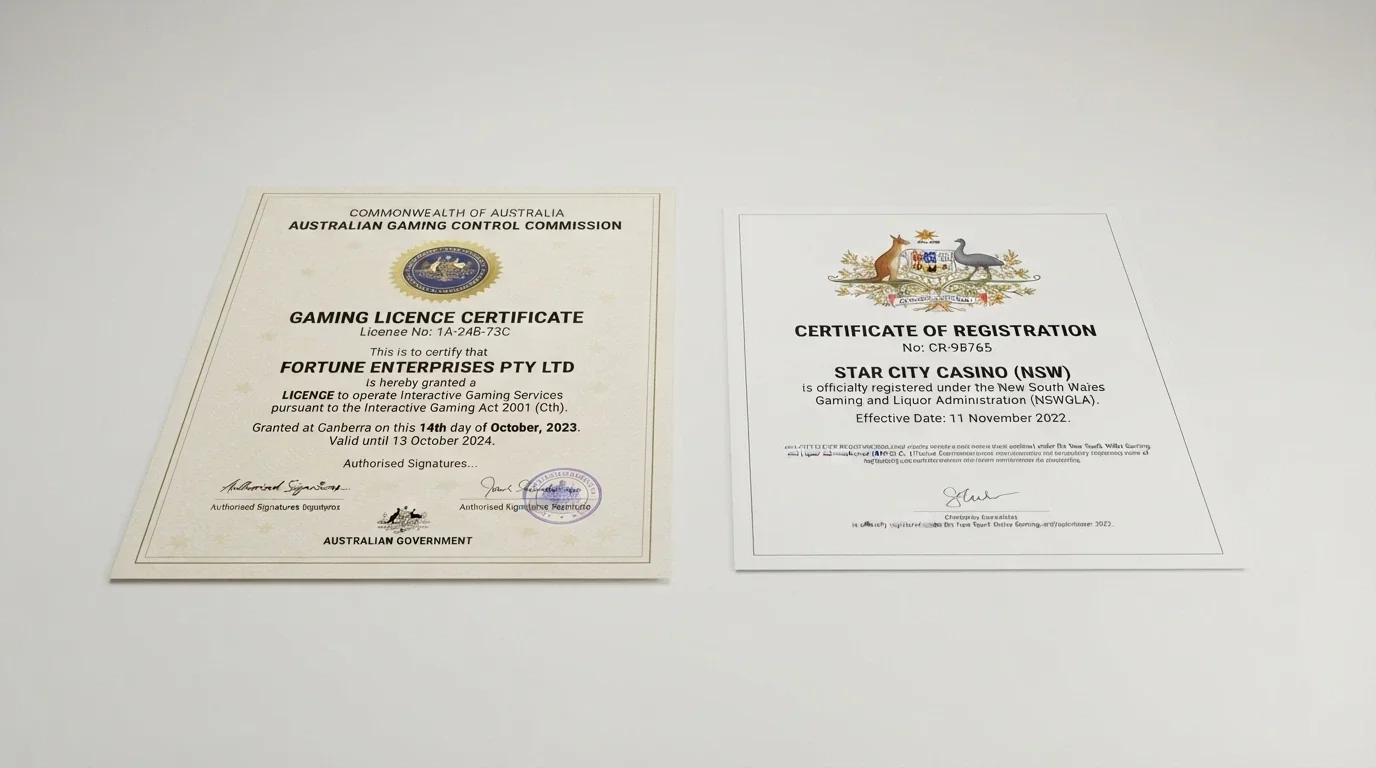
The player is not prosecuted under the IGA. That is the headline reassurance every competitor page leads with, and it is accurate. The Act targets the provider of the prohibited service, not the person in Australia who accesses it. What the Act does not do is provide the player with any of the protections an Australian licence would have guaranteed — because the protection regime and the licensing regime are the same thing, and the licensing regime does not exist for this product.
What changes on 1 January 2027 is significant but not liberalising. The Interactive Gambling Amendment (Gambling Reform) Bill 2026, which passed Parliament on 19 August 2026, gives banks and payment providers the legal mandate to restrict illegal transactions; tightens wagering advertising across TV, radio, online and venues; bans inducements to at-risk customers; and strengthens BetStop. None of this brings online pokies inside the Australian system. It tightens the screws on the system that already exists.
The IGA 2001 and what it actually prohibits
The Interactive Gambling Act 2001, strengthened by the Interactive Gambling Amendment Act 2017, prohibits offering online casino games (including online pokies) and in-play sports betting to a person in Australia. Permitted and licensable online gambling products are wagering on races and sport placed before the event begins, lotteries and keno — provided by operators licensed by a state or territory. The federal enforcer is the ACMA, which investigates complaints, issues formal warnings, brings civil penalty proceedings, refers operators for enforcement, and directs ISPs to block illegal sites. The minimum age for any commercial gambling in Australia is 18.
The ACMA has directed Australian ISPs to block 1,564 illegal gambling and affiliate websites as at March 2026, and more than 225 illegal services have withdrawn from the Australian market since the 2017 amendment took effect. Blocking is DNS-level and not absolute — the blocked sites routinely reappear under new domains — but it is the operational expression of the prohibition, and it is what has driven the offshore character of the surviving market.
What the IGA does not prohibit is wagering on a sporting event before it begins, or buying a lottery ticket, or playing keno. Those products are licensed by state and territory regulators, with the Northern Territory Racing and Wagering Commission (administered through Licensing NT) acting as the de facto national licensor. The licence terms run up to 20 years. None of those licences cover online pokies, because none of those licences can.
What Australian players give up outside the licensed market
Playing at an offshore casino means playing without any of the protections an Australian licence would have provided. There is no Australian consumer law recourse if the operator refuses a withdrawal, voids a win on a bonus-clause technicality, or closes an account. There is no ACMA complaint resolution, because the ACMA’s jurisdiction covers Australian-licensed services only. There is no access to state-based gambling dispute schemes. There is no statutory deposit ceiling, no enforced cooling-off period, no AU-mandated activity statement.
BetStop, the National Self-Exclusion Register, does not cover offshore casinos. A person who registers with BetStop is excluded from every Australian-licensed wagering service; an offshore casino is not connected to the register and will keep accepting that person’s deposits. As at 31 July 2026, 67,480 Australians had registered with BetStop, of whom 41,290 exclusions were still active — and none of those exclusions mean anything at an offshore pokies site.
The payment-method picture is the clearest tell. Since 11 June 2024, credit cards, credit-related products and digital currency (crypto) have been banned as payment methods for online wagering in Australia, under the Interactive Gambling Amendment (Credit and Other Measures) Act 2023. An operator that fails to enforce the ban faces penalties of up to A$247,500. An Australian who is asked by a gambling site for a credit card deposit or a crypto deposit is being served by someone outside the Australian rules. The legal deposit routes for licensed Australian wagering are debit card, bank transfer, PayID/Osko and BPAY. The payment method is itself a signal.
From 1 January 2027, banks and payment providers gain the power to block transactions to offshore operators under the 2026 reform package. That is the practical enforcement mechanism the prohibition has been missing, and it is the change that will most affect an Australian player who has been treating the offshore market as untouchable.
The 2026 reform bill and what changes from 1 January 2027
The Interactive Gambling Amendment (Gambling Reform) Bill 2026 passed Parliament on 19 August 2026 and its measures commence on 1 January 2027. The bill does not legalise online pokies. It tightens the prohibition’s surroundings.
The advertising package restricts wagering ads on television to no more than three per hour between 6:00 am and 8:30 pm, with a live-sport blackout from 15 minutes before until 5 minutes after a live sporting event. Radio wagering ads are barred during school drop-off and pick-up times. Broadcasting of sporting odds is banned outright. Online wagering ads may be shown only to a logged-in user verified as over 18, with an opt-out option. Wagering advertising inside sports venues and on player or official uniforms is banned. Athletes, celebrities and influencers are barred from promoting wagering products. The stated objective, per the Parliamentary Budget Office, is to “break the connection between wagering and sport, minimise exposure of children and other vulnerable people to wagering advertising, and reduce its saturation across the internet, radio and television.”
BetStop is strengthened, and direct marketing of wagering inducements is prohibited for 14 days after a customer signs up, for three months after a person deregisters from BetStop, and indefinitely for customers identified as at risk of gambling-related harm. Banks and payment providers now have the mandate to halt these transfers. Foreign-matched lotteries and online keno are prohibited.
The cumulative effect on the offshore pokies market is more friction at the deposit step, less Australian-facing advertising, and stronger consequences for the at-risk cohort. None of it makes the offshore sites disappear. What it does is make playing at them measurably harder and the protections around the player measurably thicker. The trade the player makes — accessible real-money pokies in exchange for every Australian consumer protection — does not change. What changes is how easy it is to make that trade without noticing.
PayID and beyond: how your money moves at Australian-facing pokies sites
PayID is the deposit method Australian players search for by name, because it is the method that maps onto existing trust. A PayID deposit credits in under 60 seconds at every verified AU-facing offshore casino — the mechanism is the same PayID/Osko rail a player uses to send money to a friend, just routed to a merchant instead. The deposit half of the picture is fast and frictionless. The withdrawal half is where the offshore character of the market starts to show.
The licensed Australian payment story is debit card, bank transfer, PayID/Osko and BPAY. Credit card and crypto are banned for licensed wagering. Offshore sites are not bound by that ban and routinely accept both. The legal-routes-only status that protects a player at a licensed wagering operator simply does not exist offshore.
PayID deposits — speed, limits, and the fine print
PayID deposits credit in under 60 seconds at every verified AU-facing offshore casino tested. The mechanism is Osko, the near-instant overlay on the New Payments Platform, and the casino receives the funds in AUD without a card surcharge or a foreign-exchange step. Minimum deposit thresholds vary by operator — A$10 at Bizzo is the low end of the featured set, A$30 at Skycrown and Rainbet is closer to the median, and Rocket Play’s second deposit step requires A$75.
The comparison with bank transfer and card is straightforward. Bank transfers (direct debits or OSKO NPP transfers to the operator’s BSB-and-account) take the same near-instant time on the deposit side but expose the player’s account details to the operator in a way card payments do not. Card deposits are slower to clear and carry interchange, which most operators absorb. PayID sits in the middle — fast, auditable, and tied to the player’s bank account rather than to a card — which is why Australian players reach for it first.
The credit-card-and-crypto ban that applies to licensed wagering does not reach offshore casinos. An offshore site asking for a credit card or a crypto wallet deposit is operating outside the Australian rules — the payment method is itself the tell. A player using PayID at an offshore site is using a method that is legal for licensed wagering; a player using credit or crypto at the same site is using one that is not legal anywhere in Australia.
Cashing out: withdrawal speeds, caps, and what slows your money down
PayID withdrawal is where the offshore market reveals its structure. The fastest verified PayID withdrawal times measured at Australian-facing offshore casinos are 25 minutes at Hell Spin and 35 minutes at Lucky7, with stated benchmarks of approximately five hours at slower operators. For context, a debit-card refund at a licensed wagering operator can take one to three working days; a bank transfer at an offshore site takes three to five days.
The numbers that matter beyond speed are the caps. Minimum withdrawal via PayID at AU-facing offshore casinos is typically A$25–50. Daily withdrawal caps are typically A$5,000–10,000. Weekly withdrawal caps are typically A$5,000–10,000; some operators raise the weekly limit to A$20,000 or more for accounts that have completed full verification (photo ID, proof of address, source-of-funds documentation).
The structural reason for instalment payouts on big wins is the cap itself. A A$50,000 win on a high-volatility pokie at an operator with a A$10,000 weekly cap is paid out over five weeks. The site is not stalling; the cash flow is being throttled by the operator’s own withdrawal policy. Players who do not read the cap before they play often discover it after the big win has landed, which is the worst time to learn it. The read-the-terms-before-you-play advice is not a moralism — it is the only way to avoid finding the cap at the wrong end of a five-figure payout.
Why your 2026 pokies bonus is smaller than it looks
A welcome bonus is the loudest number on a casino homepage and the smallest number in the eventual payout. The headline reads A$8,000 at Skycrown, A$1,000 at Rocket Play, A$500 at WinSpirit. The reality reads in three figures that combine: the wagering multiplier, the max-cashout cap, and the validity window. A player who reads only the headline is reading the wrong line.
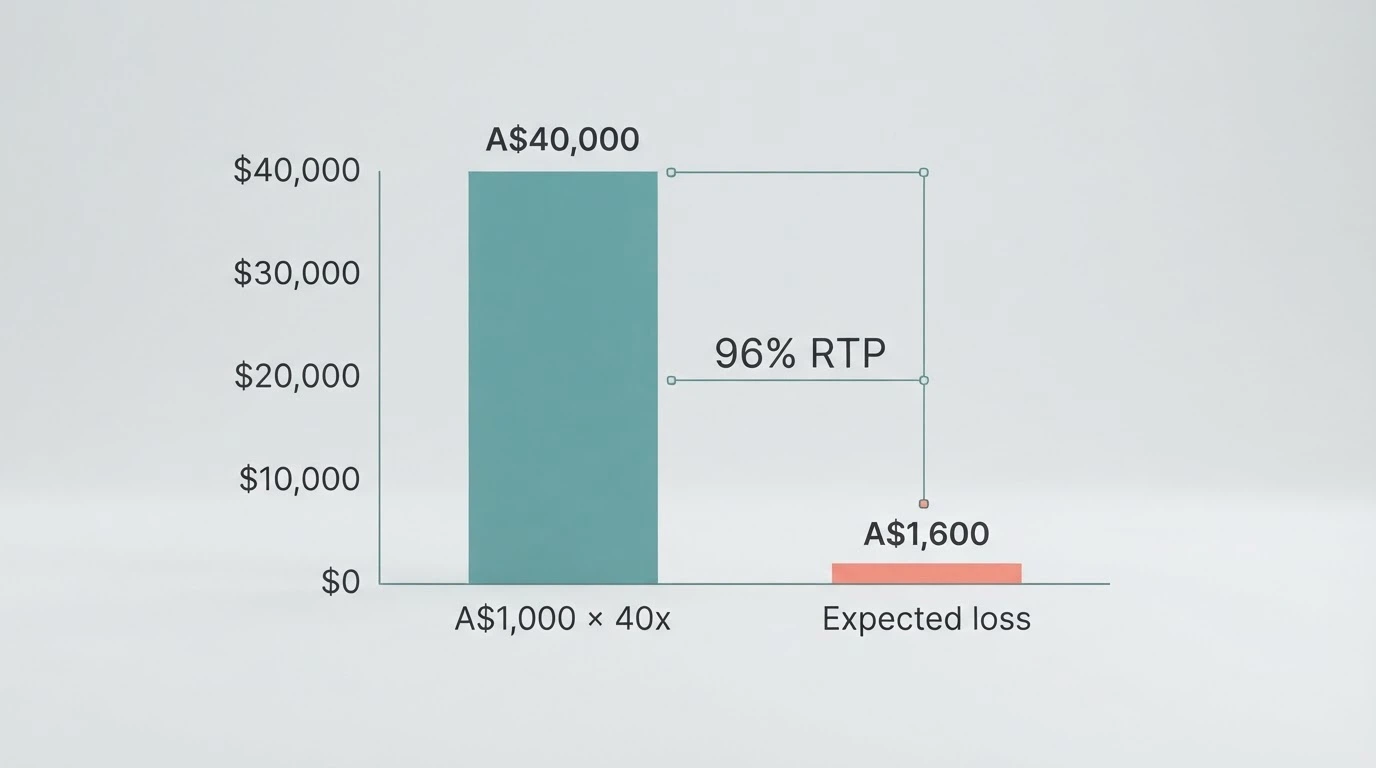
The arithmetic behind the marketing is uncomplicated. Take Skycrown’s headline A$8,000 figure, multiplied by a 40x wagering requirement: the player must turn over A$320,000 before withdrawing a cent of bonus-derived winnings. At an average pokie RTP of 96%, the house edge takes 4% of every spin, which means the expected loss on A$320,000 of turnover at 96% RTP is A$12,800. The A$8,000 bonus, in other words, is expected to cost the player A$12,800 to clear — and that is before the A$5,000 max-cashout cap is applied. A player who treats the bonus as A$5,000 of conversion ceiling and A$12,800 of expected cost is reading it correctly.
The smaller examples carry the same arithmetic. A A$1,000 bonus at 40x wagering and 96% RTP requires A$40,000 of turnover and produces A$1,600 of expected loss. A A$500 bonus at 30x wagering (the WinSpirit rate) requires A$15,000 of turnover and produces A$600 of expected loss. In every case the bonus is expected to cost roughly 60% to 160% of its headline value to clear, depending on the RTP of the games played. Higher-RTP games reduce the expected loss; lower-RTP games — and especially jackpot pokies that trade base RTP for big-win potential — increase it materially.
Wagering requirements — the number that shrinks every bonus
Wagering requirements work by multiplication. The bonus amount, multiplied by the wagering multiplier, gives the required turnover before a withdrawal is permitted. A 40x wagering requirement on a A$1,000 bonus is A$40,000 of turnover; a 30x requirement on the same bonus is A$30,000; a 20x requirement is A$20,000. The relationship is linear and mechanical, and it is the single most important number in any bonus terms.
What complicates the picture is weighting. Pokies typically contribute 100% of each spin’s value to the wagering requirement; table games and live casino games typically contribute 1% to 30%. A player who clears a pokies bonus by playing blackjack is grinding through the requirement ten to a hundred times slower than the terms imply. The 100% weighting on pokies is not a generosity — it is the assumption the bonus is built on, and the assumption disappears the moment the player leaves the pokies lobby.
The realistic ceiling for clearable wagering on a deposit bonus sits around 40x on the bonus amount. WinSpitit’s 30x on the bonus and 20x on free-spin winnings is the lowest in the featured set; Rainbet’s 40x on bonus and free-spin funds, paired with the exclusion of games above 97.4% RTP from wagering contribution, sits at the higher end. Above 40x, the bonus becomes hard to clear in absolute terms; the validity window becomes the binding constraint rather than the multiplier.
Free spins and no-deposit offers — what “free” actually means
No-deposit free spins let a player test a site without committing cash, and the search for them is large enough that competitors build dedicated pages around them. What the marketing calls “free” has three sharp edges attached.
The first is the wagering requirement on the winnings. Typical no-deposit free-spin wagering at AU-facing offshore casinos runs 30x to 50x, with 40x the recommended realistic ceiling. The second is the win limit: most no-deposit free-spin offers cap winnings at A$10 to A$100, regardless of what the spins actually return. The third is the max-bet cap during wagering: most operators cap bonus-credit bets at A$5 per spin while playing with no-deposit bonus funds, which limits both the speed of clearing and the volatility of the games that can be played.
A A$50-equivalent no-deposit package is typically structured as 50 free spins at A$1 each or 100 free spins at A$0.50 each; the spin value is fixed by the casino. The face value is the same in both cases, but the win-cap-per-spin differs in ways that affect variance. Higher-value spins with fewer total spins produce more concentrated outcomes; lower-value spins with more total spins produce flatter outcomes. Neither is structurally better — they are different games, and the bonus terms determine which one the player is being offered.
The distinction between a genuinely deposit-free offer and a deposit-gated “free spin” is worth holding in mind. A no-deposit bonus is credited on signup, before any payment; a deposit-gated free spin is added after the player has funded the account. The two carry different win limits, different wagering requirements, and different eligibility, and conflating them is the easiest way to misread what a promotion is actually offering.
Max cashout caps and validity windows — the deadline you don’t see
The max-cashout cap is the figure that converts a bonus from theoretical value to actual value. Skycrown’s A$5,000 per-welcome-bonus cap is the example the featured set sets; regular bonuses at Skycrown are capped at A$750, which is a tighter limit on a smaller bonus and a much lower ceiling than the headline suggests. The cap sits in the terms and conditions and applies regardless of how much the bonus funds technically produced.
The validity window is the deadline that converts the wagering requirement from a target into a missed opportunity. Skycrown’s standard 14-day validity and 5-day high-roller validity are the figures to compare against. A 40x wagering requirement at A$7.50 max bet on a A$1,000 bonus requires A$40,000 of turnover, which at an average 5-second spin interval is roughly 1,800 minutes of play — 30 hours. Fitting 30 hours of pokies play into 14 calendar days is achievable but not casual; fitting it into 5 days is a commitment.
The combination of wagering × validity × cashout cap sets the real ceiling on a bonus’s value, and it is the combination that should be calculated before any bonus is claimed. A small bonus with a low wagering multiplier and a long validity window often clears more value than a large bonus with a high multiplier and a short window, because the constraint is the player’s ability to grind through the requirement, not the size of the prize.
Where per-operator caps are not confirmed, the rule of thumb is to read the promotion’s terms directly before depositing. Bonus terms vary across the market in ways that matter to the eventual payout, and the terms that govern a specific offer are the only terms that govern that offer.
Pokies in your pocket: the app reality for Australian players in 2026
There is no Australian-licensed real-money pokies app. None exists at the App Store, none exists at Google Play, and none will exist after 1 January 2027 because the 2026 reform does not change the licensing framework for the product. Every mobile pokies experience an Australian player has is delivered by an offshore-licensed casino through a mobile browser or, in some cases, an Android APK downloaded from the operator’s own site.

The App Store and Google Play do not carry real-money pokies apps for Australian users because the apps would have to be tied to an Australian licence that does not exist. The studios and operators behind the major offshore pokies catalogues distribute their mobile experience through the browser rather than the app stores, and the experience is built around HTML5 and progressive web app (PWA) standards that work on any modern phone.
Why there’s no Australian-licensed pokies app — and what you’re downloading instead
No Australian online casino licence exists because no Australian online casino licence can exist — the IGA prohibits the offering. Without the licence, there is no regulator-recognised app to distribute, no Australian content-rating pathway, and no Apple or Google approval process that produces an Australian-licensed pokies app. The offshore casinos that do offer mobile pokies do so under Curacao, Anjouan or Kahnawake licences — none of which produce an Australian-licensed app.
What an Australian player downloads instead is one of three things. The first is nothing at all — the operator’s site, loaded in Safari or Chrome, behaves like an app thanks to PWA standards and does not require installation. The second is an Android APK sideloaded from the operator’s own site, bypassing Google Play. The third, less commonly, is an iOS “web app” shortcut added to the home screen. None of these is an App Store or Google Play listing, and the absence is the legal signal, not a missing feature.
Browser vs APK — how offshore pokies actually reach your phone
Browser-first PWA access is the dominant model. The site loads in 2 to 4 seconds on a 4G connection and near-instantly on Wi-Fi or 5G at well-optimised offshore casinos. Game selection is identical to desktop; payment flows are mobile-tailored rather than desktop-clipped; live-dealer tables run through the browser without a separate app. The HTML5 engine is what every major studio targets now, and the user experience is what an app would have offered ten years ago.
Android APK downloads are the alternative for players who prefer a native install or whose operator does not run a clean PWA. The APK is downloaded directly from the operator’s site, with sideloading enabled in Android settings; iOS users cannot sideload and rely on the browser or a home-screen shortcut. The APK option is more common at crypto-first operators and at casinos that prefer a controlled distribution channel over the open browser.
The practical differences for the player are minimal. Load speed is comparable, game library is identical, and the payment flows run through the same cashier. What differs is the install footprint — a PWA leaves no app icon and no APK on the device, while an APK sits in the app drawer and updates through the operator rather than Google Play. The choice is one of personal preference and of how visible the player wants the casino to be on their phone.
Free pokies, real lessons: what demo mode actually teaches you
Demo mode and free-play variants let Australian players test a pokie’s mechanics without depositing, and the search for them runs alongside the real-money search at substantial volume. What demo mode actually delivers, and what the “free online pokies win real money” phrasing actually means, are different things — and the difference is the point.

Demo mode is a fully featured version of the pokie running on play-money credits. It is offered by most major studios at the game’s developer site, by some operators as a logged-out preview, and by Rainbet across its 6,500+ game library as a permanent feature. Demo mode shows the game’s volatility, the bonus-feature frequency, the max-win ceiling, and the RTP — assuming the operator is running the full-RTP variant, which is the assumption to test rather than to make.
What demo mode does not show is the psychological cost of real-money play. The decision-making under no-stakes is fundamentally different from decision-making under stakes; the patience for a 200-spin dead stretch is harder to find when each spin is funded from a finite bankroll. Demo mode teaches the mechanics; the only thing that teaches the financial discipline is real play with a budget set in advance.
The “free online pokies win real money” phrasing is a category error. There is no path from demo play to real-money withdrawal — the play-money credits in demo mode cannot be converted and have no cash value. What the phrasing actually points to is the no-deposit bonus: free spins credited on signup, with winnings subject to wagering requirements and win caps. That mechanism is real, it is accessible without a deposit, and it is the closest thing in the market to “free pokies that pay real money.” Demo mode is the rehearsal; no-deposit bonuses are the audition.
When the reels stop being fun: help that actually works
About 2.1% of Australian adults — roughly 430,000 people — experience problem gambling; the Australian Institute of Health and Welfare put high-risk gambling at 1.8% in 2022. The help infrastructure exists. The uncomfortable truth is that the offshore pokies market sits almost entirely outside it.

The National Gambling Helpline is 1800 858 858 — free, confidential, staffed 24 hours a day, every day. Gambling Help Online, at gamblinghelponline.org.au, offers free chat and email counselling around the clock. Both services are Australian, both are funded by state and territory governments, and neither asks the caller to identify themselves or the operator they have been using.
BetStop, the National Self-Exclusion Register, has been live since 21 August 2023. As at 31 July 2026, 67,480 people had registered; 41,290 exclusions were still active — more than 60% of every person who had ever signed up. 78% of registrants were under 40, and 38% chose lifetime exclusion. One registration excludes a person from every Australian-licensed online and phone wagering service in a single step. Licensed operators must not accept the registrant or send them marketing.
BetStop does not cover offshore casinos. That is the line that has to be stated plainly. A self-excluded person who registers with BetStop is shut out of the Australian-licensed market and remains fully exposed to the offshore market. The offshore casino is not connected to the register, is not bound by its terms, and will keep accepting the registrant’s deposits and continuing to send marketing. The protection is real within its scope; the scope is narrower than the player who needs it.
The 2026 reform package strengthens BetStop from 1 January 2027 and prohibits direct marketing of wagering inducements for three months after a person deregisters from the register, and indefinitely for customers identified as at risk of gambling-related harm. The same restrictions apply to inducements for 14 days after a customer signs up with any operator. None of this closes the offshore gap. What it does is thicken the protection around the licensed market and add a red-flag mechanism that links inducement marketing to harm indicators.
If a player, a partner or a family member is reading this and recognising a pattern, the National Gambling Helpline is the first call. Free, confidential, 24/7, no questions about which offshore casino or what stake size.
How we evaluated every pokies site on this page
The ranking reflects Australian-player accessibility and term transparency — not a recommendation and not an endorsement of offshore play. Every operator in the top-10 ranking was checked against the ACMA register of blocked sites and against public licence records where those records were available. Where the ACMA register listed an operator as blocked, that finding was carried forward; where no listing appeared, the absence was noted as absence-of-finding rather than as endorsement.
The evaluation criteria, in order of weight, were:
- Licence transparency — whether the operator names its licence issuer and licence number on its public site, and whether the licence is verifiable on the issuing authority’s public register.
- Bonus-term fairness — measured qualitatively by the combination of wagering multiplier, max-cashout cap and validity window, and not by any single headline figure.
- Withdrawal speed and caps — measured against the verified PayID benchmark of 25 to 35 minutes at the fastest operators and approximately five hours at slower operators, with weekly caps of A$5,000 to A$10,000 as the typical range.
- Game-provider quality and RTP disclosure — weighted toward studios with Australian brand recognition and toward operators that publish in-game RTP consistently across their catalogue.
- AU-player accessibility — PayID deposit support, AUD account denomination, and Australian-facing customer support hours.
No single criterion produced the ranking in isolation. Operators with strong bonus terms but opaque licences were ranked below operators with weaker bonus terms and verifiable licences. Operators with broad catalogues but unverifiable game-provider rosters were treated as having a partial data record, not as having no providers. The Casino.Guru Safety Index, where available, was used as a third-party signal rather than as a primary criterion; Rocket Play’s 9.8 rating is the highest in the featured set and is reflected in the table.
The data gaps in the table — the dashes — are not failures of the operator; they are gaps in this round of research. Royal Reels, Scream Casino and Rocket Casino were not verified to the same standard as Skycrown, Rocket Play and Rainbet, and that is recorded as such. The methodology does not invent figures where research did not confirm them.
Your money, your call: what to do with everything you’ve just read
The trade an Australian player is making by playing real-money online pokies in 2026 is not complicated and is not negotiable. The accessibility is real — deposits credit in under a minute, withdrawals land within the hour at the fastest operators, and the game catalogue is broader than anything available in a domestic venue. The protection gap is real — there is no Australian consumer law recourse, no ACMA dispute resolution, no BetStop coverage, and no enforcement if the operator refuses a withdrawal on a bonus-clause technicality. Both sides of the trade are present at the same time, and the player carries both.
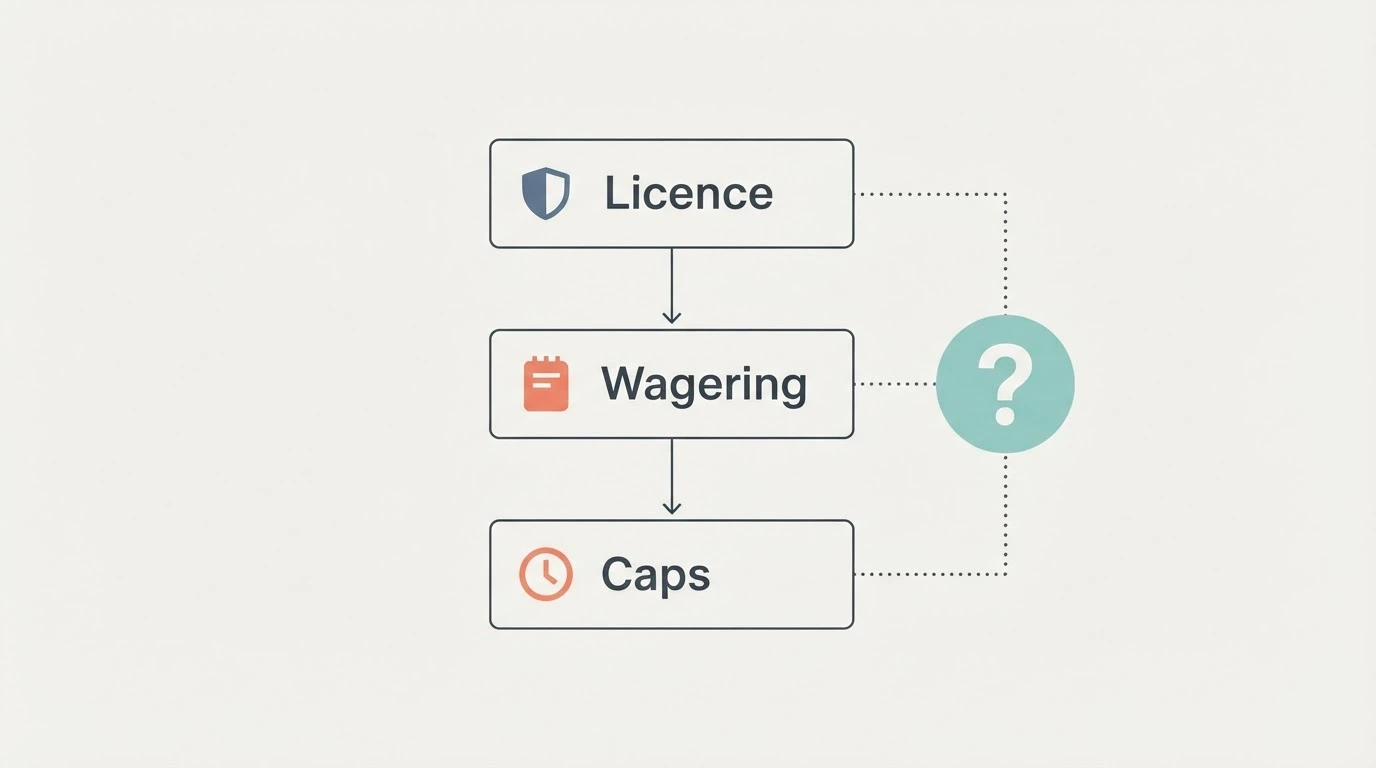
Three checks before any deposit. First, the licence — the footer of the site should name the issuer and the number, and the issuer’s public register should list the operator. Second, the wagering maths — the bonus amount multiplied by the wagering multiplier gives the required turnover, the turnover multiplied by (1 − RTP) gives the expected cost, and the max-cashout cap gives the ceiling on what is actually withdrawable. Third, the withdrawal caps — the weekly limit and the per-transaction minimum are the figures that determine how a big win is paid out. If any of those three reads opaque or refuses to be specific, that is information.
The biggest welcome bonus is rarely the best deal. Skycrown’s A$8,000 headline costs an expected A$12,800 to clear at 96% RTP and is capped at A$5,000 of actual withdrawal — a deal that returns the player less than the headline suggests and costs more than the deposit delivers. WinSpitit’s A$500 headline at 30x wagering costs an expected A$600 to clear and returns whatever the player can grind out within the validity window — a deal with fewer zeros and less arithmetic against the player. The two are not the same offer even when they sit in the same comparison table.
The payment-method tell is the easiest read. If a site asks for a credit card deposit or a crypto wallet deposit, it is operating outside every Australian rule that applies to licensed wagering. The ban on credit cards and crypto for online wagering has been in force since 11 June 2024, and an offshore site flouting it is flouting it knowingly. From 1 January 2027, banks gain the authority to restrict such payments; the deposit method that worked yesterday may not work tomorrow, and that is a feature of the changing enforcement environment rather than a quirk of any one bank.
The closing judgement is short. Playing real-money online pokies from Australia is possible, and the sites on this page are the ones Australians actually use. The player carries every risk the Australian system was built to remove — and the system was built for the licensed market, not for this one. Go in with your eyes open, or do not go in.
Frequently Asked Questions
Do I have to pay tax on pokies winnings in Australia?
No. Betting and gambling winnings are not assessable income for the ordinary punter under section 6-5 of the ITAA 1997, and gambling losses are not deductible under section 8-1 — unless the person is carrying on a business of betting or gambling. No Australian case has held the winnings of an ordinary punter assessable. The wagering operator pays tax where the customer is; that is the operator’s liability, not the player’s.
What happens if I get caught playing at an offshore online casino in Australia?
Nothing, in the criminal-law sense. The IGA targets the provider of the prohibited service, not the person in Australia who accesses it. What the player does risk is the practical consequence of the offshore relationship — no Australian consumer protection, no ACMA dispute resolution, no BetStop coverage, and a withdrawal refused on a bonus-clause technicality with no Australian court to appeal to. The enforcement direction is at the operator and at the payment layer, not at the player.
How does BetStop work and does it cover offshore pokies sites?
BetStop is the National Self-Exclusion Register, live since 21 August 2023. One registration excludes a person from every Australian-licensed online and phone wagering service. As at 31 July 2026, 67,480 people had registered, of whom 41,290 exclusions were still active. BetStop does not cover offshore casinos — those operators are not connected to the register and will keep accepting a self-excluded person’s deposits.
What are the highest-RTP pokies available to Australian players in 2026?
The best online pokie for Australian players by raw RTP in 2026 is NetEnt’s Mega Joker at 99.00% in its full-RTP configuration. Most online pokies return 94% to 97%; 97% and above is considered high RTP. Some offshore operators run reduced-RTP variants of popular titles without disclosure, so the RTP should be checked in-game at the paytable or information panel before staking meaningful amounts.
What is the difference between licensed Australian wagering operators and offshore pokies sites?
Licensed Australian wagering operators hold a state or territory licence (in practice, Northern Territory Racing and Wagering Commission licences predominate) and offer only the products the IGA permits — pre-event wagering, lotteries, keno. Offshore pokies sites offer online pokies, online casino games and in-play betting, none of which can be licensed in Australia. The Australian licence brings consumer protection, ACMA dispute resolution, BetStop coverage and credit-card/crypto payment restrictions; the offshore licence brings none of those.
Can Australian banks block payments to offshore pokies sites?
From 1 January 2027, yes — banks gain the authority to restrict transactions to offshore gambling operators under the Interactive Gambling Amendment (Gambling Reform) Bill 2026. Before that date, banks have discretion but no express mandate, and most have not routinely blocked offshore gambling transactions. The 2027 authority is a deliberate tightening rather than a clarification of pre-existing power.
Published by the Online Pokies Real Money team.